

Logging into OKX: wallet, trading, and futures — what US traders often misunderstand
Imagine you want to move from a nominal long on BTC spot into a leveraged short on perpetuals, but you hesitate because „custodial exchange equals unsafe“ or because you’re unsure how the OKX wallet, account login, and futures interface interlock. That concrete moment — decision at the keyboard with real capital on the line — is where many misconceptions matter. This piece walks through the mechanisms behind OKX’s wallet and login systems, the practical differences between spot/margin and futures, and the trade-offs a US-based trader should weigh before clicking “submit.”
I’ll correct common myths, explain how the pieces fit together mechanistically, and close with decision heuristics you can use when moving funds or opening leveraged positions. The goal is not to sell you on the platform but to give a sharper mental model of what security, custody, and leverage mean in practice on OKX and where those promises break down.
How OKX login, wallet, and custody actually work
First, separate two different loci of control: your OKX account (a custodial account on the exchange) and the OKX Web3 wallet (a self-custodial wallet you hold with a seed phrase or hardware key). When you „log in“ to the exchange, you authenticate to OKX’s centralized system using KYC-protected credentials plus mandatory 2FA and real-time threat detection. That login gives the exchange custody of assets you deposit into the exchange’s wallets; OKX states more than 95% of assets are kept in air-gapped cold storage with multi-signature withdrawal controls as a mitigation against platform-wide hacks.
By contrast, the non-custodial Web3 wallet is your private-key territory: the exchange provides tooling to manage it, but the private keys and seed phrase belong to you. Understanding this distinction matters because the security model, failure modes, and remedies differ. If OKX’s servers are compromised, custodial assets depend on cold-storage protocols and multisig governance to limit losses. If you lose a seed phrase for the non-custodial wallet, the platform cannot recover it.
Myth-bust: „Proof of Reserves means my money is safe“ and related misconceptions
Many users read „Proof of Reserves“ (PoR) and infer a guarantee of safety. PoR improves transparency by allowing verifiable snapshots that assets backing user deposits exist on-chain, but it is not a full safety guarantee. PoR is a balance-sheet audit at a point in time and does not prove that liabilities are properly segregated, that operational controls work continuously, or that internal accounting is flawless. It also cannot prevent phishing, credential theft, or smart contract exploits your personal wallet might interact with. Treat PoR as useful evidence of solvency at a snapshot, not as insurance against operational risk.
Another common misread: OKX’s cold storage claim (>95% offline) substantially reduces but does not eliminate risk. Cold storage minimizes large-scale theft from the exchange’s hot-key infrastructure, but withdrawal systems still require multisig approvals and operational security. Social-engineering attacks against staff, or bugs in the multisig logic, remain plausible failure routes. In short: cold storage reduces certain attack vectors but does not absolve users from practicing good security hygiene.
Trading mechanics: spot, margin, and futures — where the risks and choices diverge
Mechanically, spot trading is simple: exchange one token for another at market prices. Margin adds borrowed capital, amplifying gains and losses. OKX supports isolated and cross-margin modes with up to 10x leverage on margin, which changes margin call and liquidation mechanics: isolated margin confines risk to a specific position, while cross-margin pools collateral across positions, increasing capital efficiency at the cost of exposing all positions to a single bad move.
Futures and derivatives operate differently: perpetual swaps and quarterly futures are contracts that track the underlying asset but require margin and funding payments. OKX offers up to 125x leverage on certain derivatives — a product-level parameter that magnifies P&L, funding rate sensitivity, and liquidation probability. Higher leverage reduces required capital but steepens the slope of liquidation risk; small adverse moves can wipe equity. For US traders this matters because regulatory considerations and personal tax treatment also shift when trading derivatives versus spot holdings.
How the OKX DEX, Web3 wallet, and CEX interface affect workflow
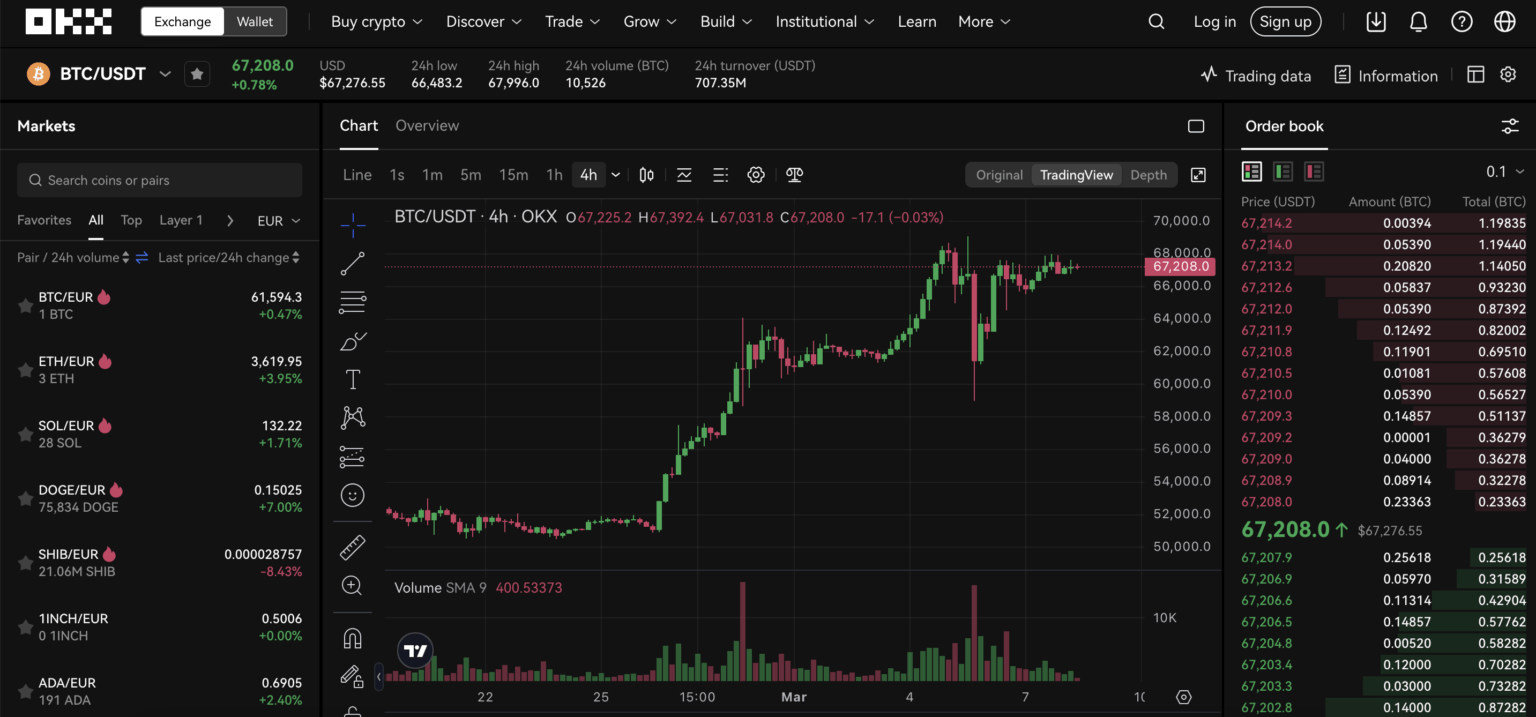
OKX’s ecosystem aims to blur the line between centralized and decentralized flows: a Web3 wallet, a DEX aggregator that sources liquidity from decentralized markets, and the central exchange interface with TradingView charting all within reach. Practically, that means you can swap on-chain via the DEX, bridge assets across chains, or deposit to the CEX without juggling multiple platforms. But those conveniences carry mixed trade-offs. Using the DEX reduces counterparty risk compared to depositing to a CEX, but exposes users to smart contract risk, bridge risks, and potential higher slippage on low-liquidity routes.
If you want to move from the non-custodial wallet to a leveraged position on the CEX, you typically have to bridge or deposit assets to your OKX account. That transfer changes the security posture (custodial custody resumes) and introduces withdrawal constraints, KYC friction, and possibly delisting risks for specific tokens — as shown by routine delistings OKX announced recently for some small-cap spot pairs. Delisting means an asset you hold might lose marginability or even tradeability on the CEX side, so keep an eye on announcements if you rely on thinly traded tokens.
Decision heuristics for a US-based trader
Here are reproducible heuristics that help convert the above into action:
– If you want pure custody and exposure without counterparty risk, keep assets in your non-custodial wallet and use on-chain DEXes; accept smart contract and seed-phrase risk. Use hardware wallets for meaningful balances.
– If you need leverage or advanced order types, deposit to the CEX but size positions so that liquidations are plausible and tolerable. Prefer isolated margin for experimental trades and cross-margin for experienced multi-position strategies when you understand contagion risk.
– Treat PoR and cold-storage statements as evidence, not insurance. Supplement by enabling all account protections: strong passwords, platform 2FA (prefer an authenticator app over SMS), withdrawal whitelists, and hardware-backed seed phrases for Web3 wallets.
Where OKX’s model is strong — and where to be skeptical
Strengths: broad cross-chain support (>130 blockchains), integrated tooling (charts, staking, NFT market), and layered security features (cold storage, 2FA, AI-driven login threat detection). For traders who want one interface to switch between spot, margin, and derivatives quickly, that integration is powerful.
Limits and open questions: delisting activity (routine and necessary for liquidity health) can strand assets; Proof of Reserves is useful but not comprehensive; and the non-custodial wallet’s safety is entirely user-dependent. Also, regulatory treatment in the US remains an external variable — rules affecting derivatives access, taxation, or custody requirements can shift platform availability or product set.
What to watch next (conditional signals)
Monitor three signal types. Operational signals: audits, PoR updates, and any public incident reports (hacks, withdrawals paused). Regulatory signals: US enforcement actions or guidance that affect derivatives offerings to US persons. Market signals: funding rates, open interest on perpetuals, and liquidity on the DEX aggregator — spikes in those metrics precede volatility-driven liquidity crunches. Changes in any of these should prompt recalibration of position size, margin buffers, and whether to keep assets on-exchange.
If OKX expands custody insurance, that would materially change the trade-off calculus for larger balances. Conversely, regulatory restrictions on derivatives or KYC friction escalations would push more traders to on-chain solutions or offshore alternatives. Both are conditional scenarios — keep watching the evidence streams rather than committing to a single belief.
FAQ
Do I need to complete KYC to trade on OKX in the US?
Yes: creating an account and accessing most trading features requires Know Your Customer (KYC) verification, which includes submitting a government ID and a facial liveness check. KYC enables higher withdrawal limits and derivatives access but also ties your trading to identity — a deliberate compliance trade-off common in US-facing platforms.
Is my non-custodial OKX Web3 wallet safer than keeping funds on the exchange?
“Safer” depends on the risk you most worry about. A self-custodial wallet eliminates counterparty and exchange insolvency risk but makes you solely responsible for seed phrase security; losing it is irreversible. Exchange custody leverages institutional controls and cold storage but introduces counterparty, operational, and regulatory risks. Use the one that matches your threat model—or split assets across both.
How does leverage differ between margin and futures on OKX?
Margin trading borrows assets against collateral and typically caps leverage (OKX offers up to 10x for margin). Futures allow higher notional exposure with product-specific leverage, up to 125x on certain derivatives. Higher leverage increases liquidation risk dramatically and requires closer monitoring of margin ratio, funding rates, and order execution slippage.
What should I do before depositing to trade futures?
Checklist: complete KYC; enable strong 2FA; transfer only what you can afford to lose; review product leverage limits and liquidation rules; start with small size in isolated margin if testing; and consider withdrawal whitelists and hardware-backed seed storage for larger balances.
For a practical next step, if you want to review OKX’s login and wallet options or start the account process from a verified page, consult this official portal for guidance: okx.